Empowering Parents dyslexia@bay™ Programme
The programme is suitable for students aged 7 and above. It is designed to help overcome all aspects of dyslexia for each student.
Contact a dyslexia@bay™
consultant in your local area
Your consultant will arrange one-on-one appointment for the student and parent where the student’s individual needs will be addressed in a systematic manner. An individual programme is designed and the parent is instructed on how to carry out the programme with their student. For a full list of trained consultants please CLICK HERE.
dyslexia@bay™
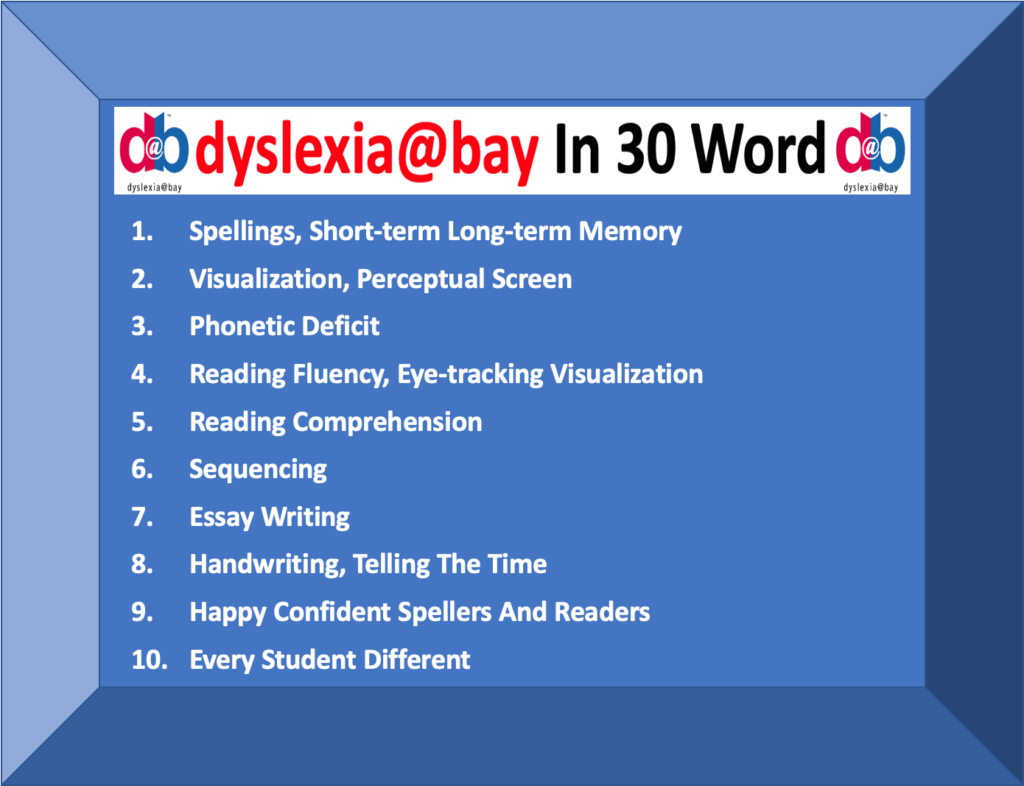
The dyslexia@bay™ System is an unique system to aid with all the aspects of dyslexia:
- spelling
- reading
- eye-tracking
- comprehension
- sequencing
- writing
- handwriting
- aspects of dyspraxia
After dealing with students with dyslexia from over 10 different countries over a period of 35 years, we have never dealt with two students with dyslexia who had the same profile.
In a doctor’s waiting room the term ”ill” can denote many different conditions such as a sprained wrist, a sore throat, ear aches, headaches, etc all of which have to be dealt with differently. There is no single magic pill to cure all. Each illness has to be diagnosed and treated individually.
In the same way “dyslexia” can cover a wide spectrum of difficulties and levels and hence there is not a one step solution. if you arrange an appointment with a dyslexia@bay™ consultant, the student’s individual needs are addressed in a systematic manner. An individual programme is designed and each parent is instructed on how to carry out the programme with each student.

The dyslexia@bay™ System is a unique comprehensive system designed to deal with all of the following problems associated with dyslexia:
Forgetting Spellings (some children can learn their spellings over a short period of time but can have difficulty with long-term recall)
Phonological Deficit (difficulty with sounding out words)
Eye-tracking Difficulties (reading in a slow or hesitant manner, losing their place on the page while reading, errors copying down from the board)
Reading comprehension (not being able to fully recall the content of the passage being read)
Sequencing Difficulties (unable to follow a simple set of instructions for e.g. go upstairs, get your pyjamas underneath your pillow, your book beside your bed and your slippers under the bed)
Writing Difficulties (unable to write down a story in sequence)
Handwriting Difficulties (difficulty writing along a ruled line, confusion of similar letters b’s / d’s or p’s / q’s)
The reasons behind these difficulties are established during the first part of a consultation with a dyslexia@bayTM Consultant. The dyslexia@bay™ consultant will screen each student for 41 individual mental processes. An individual plan is drawn up for parents to carry out with the student at home for approximately 4-6 weeks.
The dyslexia@bay™ System originated in Ireland but is now used in England, Scotland, Australia, Switzerland, the United Arab Emirates, Holland and Columbia.
Does my child have dyslexia?
For a more extensive list of difficulties see Signs and Symptoms.
Remember that dyslexia means different things to different people i.e. no two people with dyslexia are the same. Each person with dyslexia will exhibit different strengths and weakness.
Some people with dyslexia can have difficulties reading words on a page. Other people can read well at a mechanical level but will not remember what they have read.
Some people with dyslexia will forget their spellings very soon after learning them, while others can remember the spellings for each spelling test but if you ask those same spellings three weeks later they are “gone”.
Some people with dyslexia can have poor balance while others can be wonderful sports people.
As each person with dyslexia is different, each person with dyslexia should be taught differently. The dyslexia@bay™ System is designed to work with individuals on a one-to-one basis in the presence of a parent/teacher. An individual programme of mental skills and eye-tracking exercises is designed for each person to alleviate the symptoms and to aid learning. During the consultation the parent/teacher is given guidance on how to assist the student with this 4-6 week programme at home or in school.
Children under the age of 7 with reading and spelling difficulties will benefit from Murphy Reading (www.murphyreading.com).